
Courtyard House Design in Jodhpur: Climate, Performance & Contemporary Living
- panksv
- Apr 21
- 5 min read
Courtyard houses are often described as traditional—but in reality, they are highly refined environmental systems.
In places like Jodhpur, where the climate is extreme for most of the year, the courtyard becomes more than a spatial device. It starts influencing how a house breathes, how it cools down, and how people experience it through the day.
Historically, courtyard houses—from Rajasthani havelis to South Indian homes—were built around this idea of climate response. The central open space allowed light, ventilation, and social life to coexist within a protected environment. (Wikipedia)
Today, these principles are being revisited—not as nostalgia, but as performance-driven design.
At Oreira Architecture Studio, we are implying ways to make it more effective reducing the use of artificial HVAC & Lighting and make it more effective.
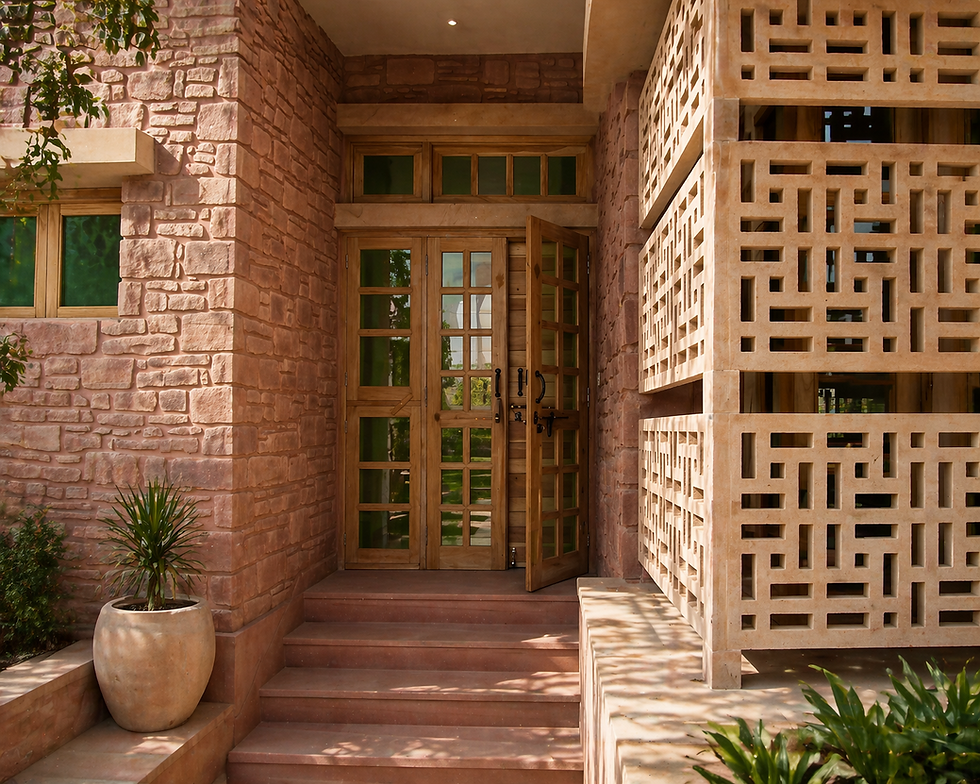
How a Courtyard House Regulates Temperature
A courtyard works through a combination of airflow, shading, and thermal mass.
As the sun heats the built surfaces, warm air begins to rise. The courtyard acts as a vertical escape path, allowing this hot air to move upward and out. In doing so, it pulls cooler air from shaded areas into surrounding rooms.
This constant movement of air improves comfort significantly.
Studies and observations in Indian contexts show that:
Courtyard houses can feel 2–4°C cooler than conventional layouts
With vegetation and shading, localized cooling can be even higher
Passive strategies reduce dependence on mechanical cooling significantly (Scribd)
Traditional systems like wadas and havelis used this effectively—where the courtyard acted almost like a natural thermostat for the house. (Wikipedia)

Stack Effect & Vertical Air Movement
While courtyards naturally move air, this can be enhanced further.
One method is the use of stack chimneys or vertical shafts. These work on the same principle—hot air rises—but in a more controlled way.
As air heats up within the shaft, it rises and exits quickly. This creates a slight suction effect, drawing cooler air into the living spaces.
When combined:
Courtyard → introduces air and light
Stack chimney → accelerates air movement
This improves ventilation noticeably, especially during peak summer conditions.
In many contemporary buildings, these chimneys are integrated within staircases or double-height spaces, becoming part of the architecture rather than separate systems.
Refer our Bio at https://www.oreirastudio.com/about-oreira-mumbai-jodhpur
Night Purge: Cooling the House After Sunset
Another simple but effective strategy is the night purge system.
In hot-dry climates like Jodhpur, nights are significantly cooler than days. By opening the house strategically at night—through courtyards, windows, and vertical shafts—cool air is allowed to flush out the accumulated heat from walls and interiors.
By morning, the structure starts at a much lower temperature, delaying heat build-up through the day.
When used correctly:
Indoor temperatures remain stable longer
Cooling loads reduce
Spaces feel more comfortable without immediate AC use
This is one of the simplest passive strategies—but also one of the most effective.
Learning from Built Examples (TERI & Sustainable Campuses)
Several contemporary projects in India have already explored these ideas at scale.
For instance, projects by the The Energy and Resources Institute integrate passive cooling strategies such as:
Earth-air tunnel systems (geothermal cooling)
Cross ventilation planning
Daylighting and shading
The TERI campus in New Delhi uses underground air tunnels to cool incoming air before it enters the building—reducing energy consumption while maintaining comfort. (www.slideshare.net)
Similarly, many institutional and residential projects today combine courtyards with passive systems to reduce energy demand and improve indoor climate.
These are not experimental ideas anymore—they are tested, working systems.
Geothermal Cooling: Using the Ground as a Resource
One of the more advanced strategies is geothermal or earth-air cooling.
At a depth of about 2–4 meters, the ground temperature remains relatively stable. Air passed through underground pipes gets cooled naturally before entering the house.
In practical terms:
Incoming air can be 4–6°C cooler
The load on air-conditioning systems reduces significantly
When combined with courtyards and stack ventilation:
Courtyard distributes air
Geothermal system pre-cools it
Stack chimney removes hot air
This creates a continuous passive cooling loop.
While not always necessary, it becomes particularly effective in larger homes and villas where long-term efficiency is a priority.
Automation & Smart Control
What is interesting today is how traditional systems can be combined with modern technology.
Automation can play a subtle but important role:
Sensors can open or close skylights based on temperature
Windows can be programmed for night purge cycles
Shading devices can adjust with sun movement
This allows the house to respond dynamically—something that traditional systems relied on manual operation for.
The combination of passive design and automation creates a more responsive and efficient living environment.
Towards Net-Zero Homes
This raises an important question—can a courtyard house become a net-zero building?
In many cases, yes.
When passive strategies reduce cooling demand, and renewable systems like solar panels are added, the overall energy consumption can approach zero.
Courtyard-based planning helps by:
Lowering energy demand first
Making renewable systems more effective
The goal is not just to produce energy—but to reduce the need for it in the first place.
This is where traditional wisdom and contemporary technology begin to align.

FAQs
Can a courtyard work in a small plot?
Yes, but proportions become critical. Even smaller courtyards can work as light wells if designed correctly. Suggested plot sizes are above 200-250 Sq yards to plan Living Areas as well as good scale courtyard.
Will it increase construction cost?
Not necessarily, rather generally the contractor shall only charge for the peripheral wall constructed (including foundation). The open cutout area is generally not included in the construction area. This might reduce your overall Built up Area but may reduce long-term operational costs significantly.
Does it work in humid climates?
Yes, but design needs to adapt—ventilation becomes more critical than thermal mass.
Can it be used in apartments?
Not traditionally, but smaller internal courts or light wells can replicate similar effects. The whole apartment building has to be planning in such a manner to gain effects of courtyard planning.
Is maintenance difficult?
No more than a garden space. Proper drainage and detailing are key. The walls could be maintenance free outdoor finish with loose soil or hard paved on the ground. It depends if you're planning to keep potted plants or planting vegetation in the ground. The surrounding areas including walls shall be waterproofed as done in exterior walls, so that moisture/water doesn't damage.
Is it relevant in modern architecture?
Yes ! More than ever—especially with rising temperatures and energy costs. With modern architecture also it could seamlessly integrated into your design & will help a lot with Natural Lighting and Views.
Conclusion
Courtyard houses are not just a memory of the past—they are a response to very real challenges we face today.
When combined with strategies like stack ventilation, night purge, geothermal cooling, and even automation, they become highly efficient systems that shape both comfort and experience.
In a city like Jodhpur, designing with climate is not optional—it is essential.
And in many ways, the courtyard remains one of the most effective ways to do that.
Book a consultation regarding your upcoming project.


Comments